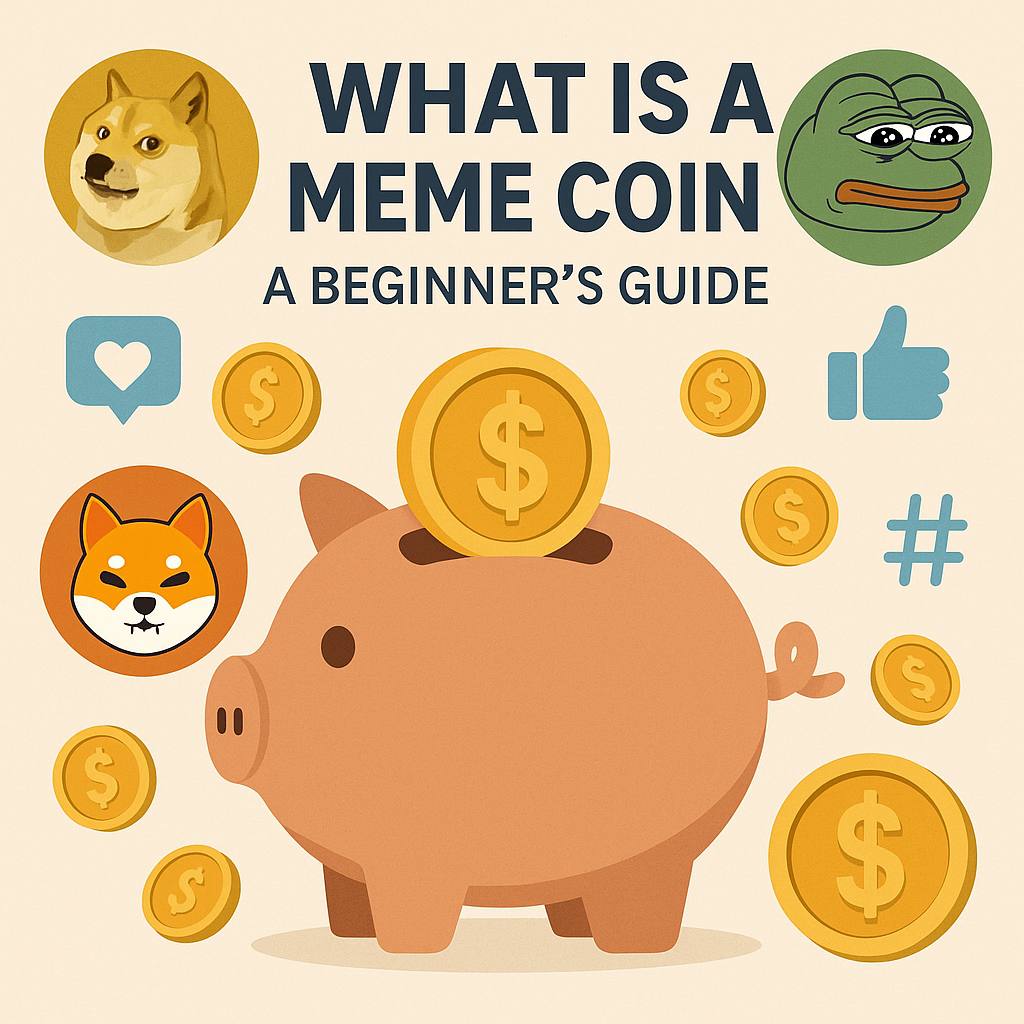
What is a Meme Coin? A Beginner’s Guide
What is a Meme Coin? A Beginner’s Guide

Imagine a coin that started as a joke on the internet but suddenly made early buyers millionaires.
That’s the story of meme coins — tokens like Dogecoin, Shiba Inu, or PEPE that thrive on humor,
community, and viral culture rather than on complex utility. For many, meme coins are the entry gate
into the fascinating world of crypto trading. But what are they really, and why do they matter?
This beginner’s guide will take you through everything you need to know.
🔑 Key Takeaways
- Meme coins are cryptocurrencies inspired by internet jokes, pop culture, or viral trends.
- They often have massive supply (trillions of tokens) and rely on strong community engagement.
- Unlike traditional cryptocurrencies, meme coins rarely start with technical utility.
- Volatility is extreme — huge pumps can lead to equally sharp dumps.
- Understanding tokenomics, market cap, and liquidity is essential before investing.
1. Defining Meme Coins in Simple Terms
A meme coin is a type of cryptocurrency that gains popularity mostly through online communities,
memes, and social media hype rather than through solving a specific problem. While Bitcoin was
created to address global finance, meme coins are born from humor and internet culture.
The first meme coin, Dogecoin, launched in December 2013. Its creators, Billy Markus and Jackson Palmer,
designed it as a parody of Bitcoin, featuring the popular Shiba Inu dog from the “Doge” meme.
What started as satire became one of the most recognizable names in the crypto industry, with
billion-dollar valuations at its peak.
“Sometimes what begins as a joke can become a revolution — if the crowd believes in it.”
— Inspired by the way Dogecoin rose from meme to mainstream.
Today, thousands of meme coins exist, each competing for attention and investment. While only a handful
reach mainstream recognition, they remind us of how powerful internet culture has become in shaping
financial markets.
2. Why Meme Coins Captivate Beginners
Beginners are often drawn to meme coins for one simple reason: affordability. Unlike Bitcoin or Ethereum,
where a single unit might cost thousands of dollars, meme coins often trade at fractions of a cent.
This creates the psychological appeal that one can own millions or even billions of tokens for a
small investment.
Another major factor is community engagement. Meme coin communities are among the most passionate,
producing content, running social media campaigns, and even crowdfunding projects to push adoption.
Think of Dogecoin sponsoring a NASCAR car or Shiba Inu launching its own decentralized exchange.
In a way, buying meme coins often feels like joining a cultural movement rather than a financial
investment. For many young traders (investors), especially in countries like India, Brazil, and Nigeria,
meme coins represent not just speculation but also participation in a global trend.
“When you buy a meme coin, you’re not just buying a token. You’re buying into a story, a joke,
and a community.”
3. Meme Coins vs. Traditional Cryptocurrencies
The difference between meme coins and traditional cryptocurrencies can be understood in both technical
and cultural terms. Bitcoin was created as a decentralized alternative to money. Ethereum was built
to support smart contracts and decentralized applications. Both had clear goals and technological
roadmaps.
Meme coins, on the other hand, rarely begin with such ambitions. Their goal is attention, virality,
and speculative excitement. That doesn’t mean they cannot evolve. Shiba Inu, for instance, started
as a meme token but expanded into an ecosystem with a decentralized exchange (ShibaSwap), NFTs, and
even metaverse projects.
| Aspect | Meme Coins | Traditional Cryptocurrencies |
|---|---|---|
| Origin | Internet jokes, memes, or cultural trends | Created to solve financial/technical problems |
| Utility | Limited at launch, may evolve later | Strong use-cases (payments, contracts, apps) |
| Volatility | Extreme, hype-driven | Still volatile but often backed by fundamentals |
| Community Role | Central driver of success | Supportive but not the only factor |
| Examples | DOGE, SHIB, PEPE, FLOKI | BTC, ETH, LTC, ADA |
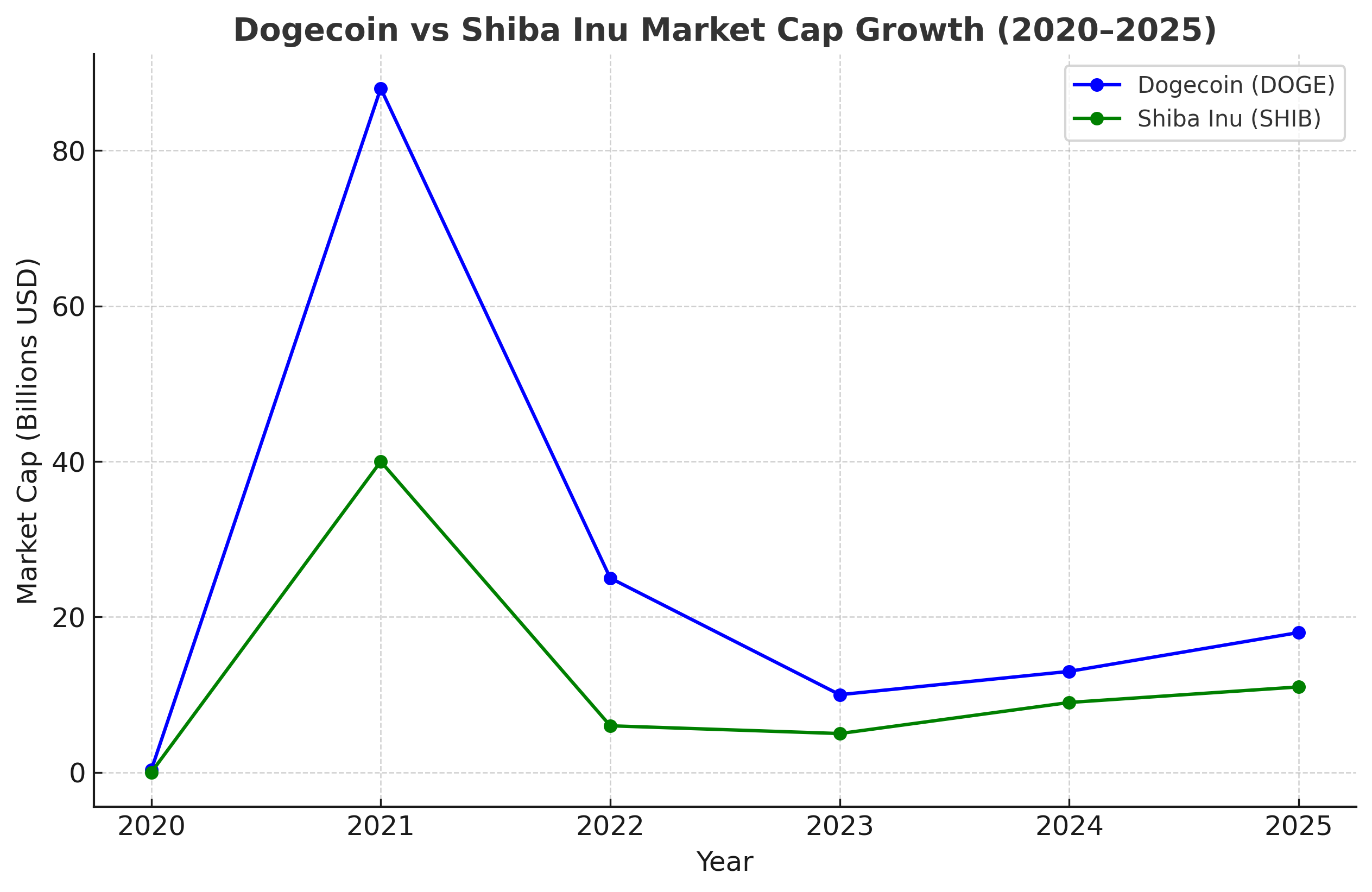
Looking at the chart above, you can clearly see how Dogecoin and Shiba Inu experienced exponential
growth during their respective bull runs. These aren’t gradual climbs like in traditional markets —
they’re sudden, meme-driven explosions.
4. A Brief History of Meme Coins: From Dogecoin to PEPE
The story of meme coins begins with Dogecoin in 2013. Its logo, a Shiba Inu dog with comic
sans captions like “much wow” and “so crypto,” was never intended to compete with Bitcoin. Yet by 2021,
Dogecoin’s market cap exceeded $88 billion — higher than many established corporations.
After Dogecoin, new meme coins followed every major crypto bull run:
- 2017: Multiple dog-themed tokens appeared during the ICO craze.
- 2020–2021: Shiba Inu (SHIB) emerged, branding itself the “Dogecoin killer.”
It hit a peak market cap of $40 billion. - 2023: PEPE coin launched, inspired by the internet frog meme, quickly reaching
billions in market cap within weeks. - 2024–2025: FLOKI and other community-driven tokens gained traction, often tied
to celebrity tweets and influencer marketing.
“History shows us that meme coins thrive during hype cycles, but only a few survive the test of time.”
5. Understanding Tokenomics in Meme Coins
Tokenomics is the study of a coin’s economic model: supply, distribution, and incentives.
Meme coins often feature enormous supplies — sometimes in the trillions or quadrillions.
This makes each coin affordable but also highly inflationary unless burns or restrictions are introduced.
Example: SHIB launched with a total supply of 1 quadrillion tokens. Half was locked in Uniswap, and
the other half was sent to Ethereum’s co-founder Vitalik Buterin. In a shocking move, he burned most
of his allocation, instantly reducing supply and boosting scarcity.
Tokenomics also covers distribution. Is most of the supply held by insiders or whales? If yes,
manipulation becomes likely. A healthier distribution involves wider community ownership and
mechanisms like burns, reflections (small transaction fees redistributed to holders), or staking
rewards.
6. Meme Coin Supply: Inflation vs. Deflation
Supply mechanics are critical in deciding the long-term potential of a meme coin.
- Inflationary coins: Dogecoin mints 5 billion new coins each year. This ensures
miners get incentives but creates downward price pressure unless demand constantly grows. - Deflationary coins: Shiba Inu employs token burns, where portions of supply are
permanently destroyed, making existing tokens scarcer.
To put it in perspective: inflationary coins resemble a balloon being filled continuously with air.
Deflationary coins, on the other hand, slowly release tokens into oblivion, making each remaining
piece more valuable if demand persists.
“A proverb from China says: ‘The best time to plant a tree was 20 years ago. The second-best time
is now.’ Similarly, the best time to hold deflationary assets is before supply tightens.”
7. Why Meme Coins Pump and Dump
Meme coins are infamous for their pump-and-dump cycles. A single tweet, meme, or
celebrity mention can send prices soaring within hours. But the same hype can fade just as quickly,
leading to catastrophic losses.
For instance, Elon Musk’s tweets about Dogecoin in 2021 triggered multiple price spikes. At one point,
DOGE gained over 400% in a single week. Yet by mid-2022, prices had collapsed by more than 80% from
the peak.
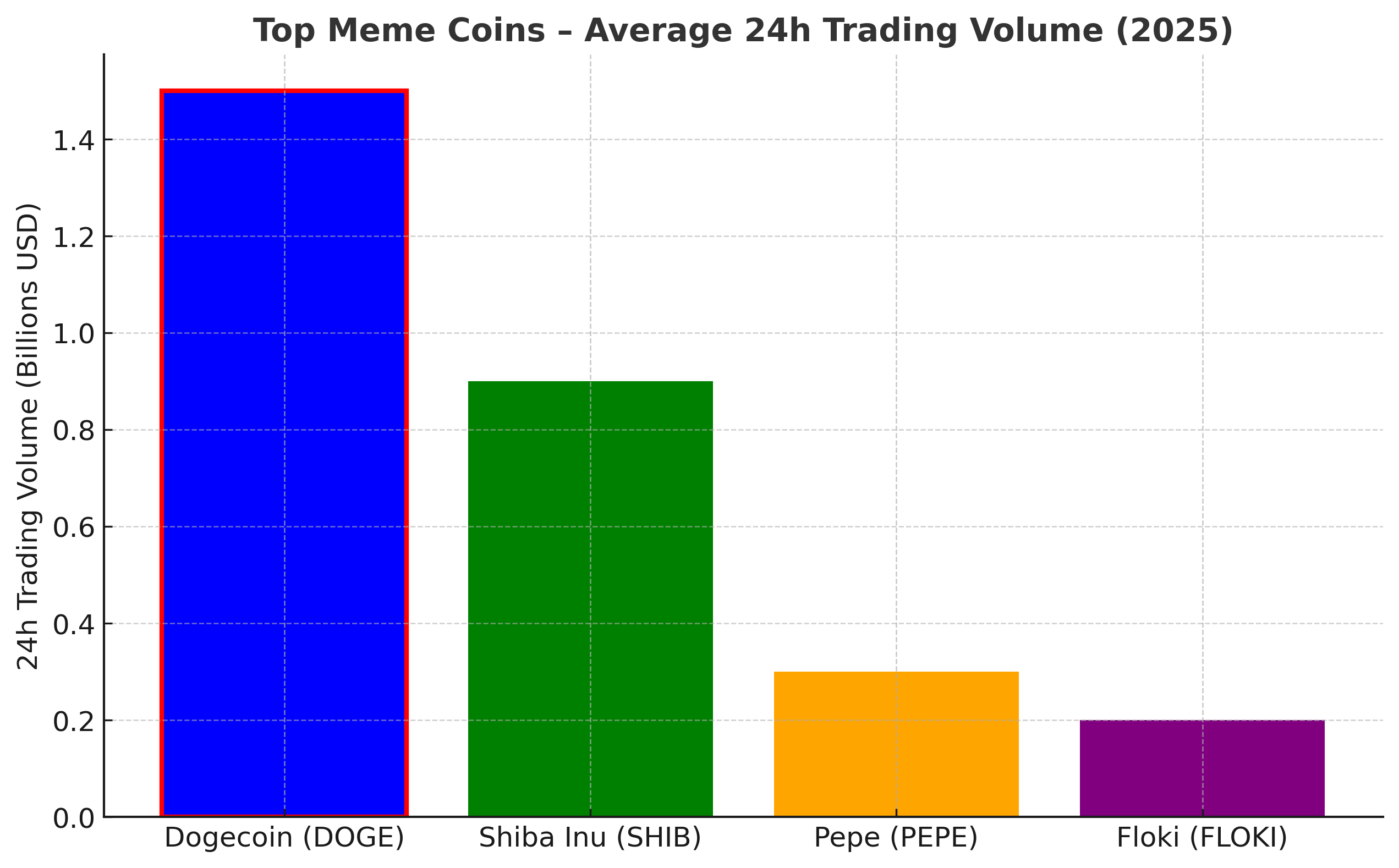
Pump-and-dump cycles often correlate with trading volume surges (see chart above).
When community buzz aligns with high liquidity, whales (large holders) often take profits,
leaving retail investors with losses.
This is where caution is critical: never invest more than you can afford to lose, and avoid
making decisions solely based on hype or social media trends.
4. A Brief History of Meme Coins: From Dogecoin to PEPE
The story of meme coins begins with Dogecoin in 2013. Its logo, a Shiba Inu dog with comic
sans captions like “much wow” and “so crypto,” was never intended to compete with Bitcoin. Yet by 2021,
Dogecoin’s market cap exceeded $88 billion — higher than many established corporations.
After Dogecoin, new meme coins followed every major crypto bull run:
- 2017: Multiple dog-themed tokens appeared during the ICO craze.
- 2020–2021: Shiba Inu (SHIB) emerged, branding itself the “Dogecoin killer.”
It hit a peak market cap of $40 billion. - 2023: PEPE coin launched, inspired by the internet frog meme, quickly reaching
billions in market cap within weeks. - 2024–2025: FLOKI and other community-driven tokens gained traction, often tied
to celebrity tweets and influencer marketing.
“History shows us that meme coins thrive during hype cycles, but only a few survive the test of time.”
5. Understanding Tokenomics in Meme Coins
Tokenomics is the study of a coin’s economic model: supply, distribution, and incentives.
Meme coins often feature enormous supplies — sometimes in the trillions or quadrillions.
This makes each coin affordable but also highly inflationary unless burns or restrictions are introduced.
Example: SHIB launched with a total supply of 1 quadrillion tokens. Half was locked in Uniswap, and
the other half was sent to Ethereum’s co-founder Vitalik Buterin. In a shocking move, he burned most
of his allocation, instantly reducing supply and boosting scarcity.
Tokenomics also covers distribution. Is most of the supply held by insiders or whales? If yes,
manipulation becomes likely. A healthier distribution involves wider community ownership and
mechanisms like burns, reflections (small transaction fees redistributed to holders), or staking
rewards.
6. Meme Coin Supply: Inflation vs. Deflation
Supply mechanics are critical in deciding the long-term potential of a meme coin.
- Inflationary coins: Dogecoin mints 5 billion new coins each year. This ensures
miners get incentives but creates downward price pressure unless demand constantly grows. - Deflationary coins: Shiba Inu employs token burns, where portions of supply are
permanently destroyed, making existing tokens scarcer.
To put it in perspective: inflationary coins resemble a balloon being filled continuously with air.
Deflationary coins, on the other hand, slowly release tokens into oblivion, making each remaining
piece more valuable if demand persists.
“A proverb from China says: ‘The best time to plant a tree was 20 years ago. The second-best time
is now.’ Similarly, the best time to hold deflationary assets is before supply tightens.”
7. Why Meme Coins Pump and Dump
Meme coins are infamous for their pump-and-dump cycles. A single tweet, meme, or
celebrity mention can send prices soaring within hours. But the same hype can fade just as quickly,
leading to catastrophic losses.
For instance, Elon Musk’s tweets about Dogecoin in 2021 triggered multiple price spikes. At one point,
DOGE gained over 400% in a single week. Yet by mid-2022, prices had collapsed by more than 80% from
the peak.
Pump-and-dump cycles often correlate with trading volume surges (see chart above).
When community buzz aligns with high liquidity, whales (large holders) often take profits,
leaving retail investors with losses.
This is where caution is critical: never invest more than you can afford to lose, and avoid
making decisions solely based on hype or social media trends.
12. Benefits of Investing in Meme Coins
When people hear the phrase “meme coin,” their first reaction is often laughter.
How could a coin with a dog or frog logo change anything? Yet beneath the humor, meme coins
bring several unique benefits that attract millions of investors (traders) across the globe.
Let’s unpack why they continue to fascinate both newcomers and experienced crypto participants.
1. Accessibility and Affordability
Meme coins usually trade at fractions of a cent, which makes them highly accessible.
A beginner in India, for example, might buy 1,000,000 SHIB for less than the price of a coffee.
Psychologically, owning “millions of coins” feels empowering. Unlike Bitcoin or Ethereum,
which require larger capital for meaningful exposure, meme coins let everyday people
enter the market without feeling excluded.
2. Community Belonging
Meme coins are more than assets; they are movements. Joining the DOGE or SHIB army means joining
a tribe of like-minded enthusiasts. Telegram groups, Discord servers, Reddit threads — all
provide a sense of belonging. For many young investors, this sense of community is as valuable
as potential profits.
3. High Return Potential
While risky, the growth potential of meme coins is undeniable. Dogecoin rose from fractions
of a cent to $0.73 in May 2021, creating overnight millionaires. Shiba Inu gained over
46,000,000% in one year. Even if only a few meme coins achieve such growth, the stories
keep attracting speculative capital.
4. Entertainment and Engagement
Unlike dry financial products, meme coins are fun. They use memes, jokes, and viral culture
to stay in the spotlight. In the West, this is akin to fantasy sports leagues; in Asia,
it’s like community lotteries — entertaining, social, and exciting.
5. Gateway to Learning Crypto
Many people’s first crypto purchase is a meme coin. By engaging with these tokens, users
learn about wallets, decentralized exchanges, liquidity pools, and trading basics.
It’s a low-stakes way to get practical crypto education.
| Benefit | Description | Example |
|---|---|---|
| Accessibility | Low entry cost allows mass participation | 1M SHIB for less than $20 in 2021 |
| Community | Strong sense of belonging & identity | DOGE Reddit community of 2M+ members |
| High Returns | Occasional exponential gains | DOGE +12,000% in 2021 |
| Entertainment | Humor and memes keep users engaged | PEPE coin trending on Twitter |
| Education | Entry-level crypto learning | First-time wallet setup for SHIB buyers |
Quote from Warren Buffett: “Price is what you pay. Value is what you get.”
In meme coins, the price may be tiny, but the perceived community value is massive.
13. Issues with Meme Coins
Every rose has its thorns. While meme coins offer benefits, they also face significant issues.
Some are structural, others cultural, and a few are rooted in human psychology. Understanding
these issues is crucial before diving in.
1. Lack of Utility
Most meme coins launch without real-world use cases. Unlike Ethereum powering smart contracts
or Solana enabling high-speed apps, meme coins often rely solely on community hype.
This makes their long-term value questionable.
2. Oversupply Problem
Tokens like SHIB have quadrillions in supply. Even with burns, the oversupply creates price
ceilings. This makes hitting Bitcoin-level valuations nearly impossible.
3. Centralized Ownership
In many meme coins, a few wallets hold the majority of supply. This creates massive risk of
whale manipulation. If a top holder sells, the price can collapse instantly.
4. Exchange Limitations
Not all meme coins are listed on major exchanges. A coin may thrive on decentralized exchanges,
but lack of availability on platforms like Coinbase or Binance limits mainstream adoption.
5. Regulatory Uncertainty
Regulators worldwide struggle to categorize meme coins. Are they securities? Commodities?
Gambling tools? This uncertainty can lead to sudden bans or restrictions.
African proverb: “When the music changes, so does the dance.”
In crypto, when regulations change, entire markets must adapt.
| Issue | Impact | Example |
|---|---|---|
| No Utility | Value depends purely on hype | Many 2021 meme coins vanished in 2022 |
| Oversupply | Hard to achieve high token prices | 1 Quadrillion SHIB tokens |
| Centralized Holdings | Whale manipulation risk | Top 5 wallets holding >50% supply |
| Exchange Barriers | Lower liquidity and trust | FLOKI not on all Tier-1 exchanges |
| Regulation | Potential restrictions or bans | India’s tax rules reducing meme coin trading |
14. Risks Associated with Meme Coins
Investing in meme coins is like playing a high-stakes game — thrilling but dangerous.
The risks are multifaceted and should not be ignored.
1. Extreme Volatility
Price swings can be brutal. A coin may jump 300% in a week and lose 70% the next.
Investors without risk tolerance may face severe losses.
2. Rug Pulls and Scams
Some meme coins are outright scams. Developers pump hype, attract liquidity, then withdraw funds.
In 2021, the infamous “Squid Game Token” collapsed from $2,800 to nearly zero in days.
3. Hype Dependency
Meme coins depend heavily on social media buzz. Once hype dies, so does price action.
Unlike utility coins, they lack sustainable demand.
4. Emotional Investing
Investors often buy meme coins based on FOMO (fear of missing out). Emotional decisions
lead to poor outcomes. Studies show retail traders often buy at peaks and sell at lows.
5. Potential for Total Loss
While blue-chip cryptos rarely go to zero, meme coins often do. Thousands of meme tokens
from 2021 are now worthless.
| Risk | Impact | Real Example |
|---|---|---|
| Volatility | Large short-term gains and losses | DOGE fell 80% post-2021 peak |
| Scams | Loss of entire investment | Squid Token rug pull 2021 |
| Hype Dependency | Value fades with attention | Many TikTok-pumped coins of 2020–21 |
| Emotional Trading | Buying tops, selling bottoms | Retail panic during May 2021 crash |
| Total Loss | Coin value can reach zero | Over 80% of 2021 meme tokens dead |
American proverb: “Don’t put all your eggs in one basket.”
Meme coin traders must diversify to survive.
To put it simply: meme coins are like spicy food. Delicious and addictive, but too much
without preparation can burn you badly. In the same way, meme coins can offer short bursts
of financial excitement but pose significant danger if consumed recklessly.
15. Meme Coins in Global Culture
Meme coins are not just digital assets; they have become cultural phenomena that reflect the humor,
frustrations, and creativity of internet generations worldwide. What began as a niche joke in the
United States spread to Europe, Asia, Africa, and Latin America within a few short years.
In the US, Dogecoin became a part of mainstream culture when Elon Musk called it “the people’s crypto.”
In Nigeria, meme coins are embraced by a young, tech-savvy population seeking alternatives to an
unstable local currency. In Japan, where the Shiba Inu dog originates, SHIB resonated strongly as
a national symbol turned global sensation.
These cultural adoptions highlight one key fact: meme coins are more than money. They are global
conversations. The memes, jokes, and community interactions transcend borders, languages, and even
financial literacy levels.
Chinese proverb: “One beam, no matter how big, cannot support an entire house.”
A meme coin without a community cannot thrive, no matter its design.
16. Childhood Connections and Human Psychology
Think back to your childhood. Many of us played board games like Monopoly or childhood versions of
“banking games.” Some even created “currencies” at home or in school as tokens to trade marbles,
toys, or sweets. Meme coins tap into the same psychological wiring.
Owning millions of SHIB or FLOKI feels like revisiting those childhood fantasies where we held
bundles of pretend money. It is this sense of imagination and possibility that draws people into
meme coin culture. The nostalgia is powerful — and it works across countries.
In India, children used to play “business” by exchanging paper chits with handwritten values.
In Europe, small village fairs often had tokens or wooden coins for rides and games. In Latin
America, kids often created “store games” where bottle caps acted as coins. Meme coins mirror
these childhood traditions, giving adults a digital form of the same joy.
17. Meme Coins and Sports Analogies
Sports metaphors perfectly capture the unpredictable world of meme coins. Investing in them is
similar to cheering for an underdog team. They might lose most matches, but occasionally, they
upset the champions and make history.
Consider Dogecoin as the “Leicester City” of crypto, pulling off an unimaginable win in 2016
Premier League terms when it hit $0.73 in 2021. Or think of Shiba Inu as the “rookie fighter”
in boxing, coming out of nowhere to challenge the champions.
Across the world, from cricket in India to football in Europe and basketball in the US,
sports fans love comeback stories. Meme coins thrive on the same spirit — unpredictability
and hope for a miraculous win.
African proverb: “However long the night, the dawn will break.”
Meme coin traders often hold on during bear markets in hope of another bull run.
18. Food and Meme Coins: Strange but True
Believe it or not, food analogies explain meme coins beautifully. Meme coins are like street food.
They’re cheap, widely available, loved by the masses, and often more exciting than gourmet dishes.
Just as street food can sometimes make you sick, meme coins can burn your portfolio if consumed
without caution. But the thrill keeps people coming back. In the US, fast food chains like McDonald’s
are part of everyday culture. In India, spicy street chaats attract millions daily. In China, dumplings
and noodles sold on street corners fuel entire cities. Meme coins are the digital equivalent: easy,
fun, risky, and addictive.
Shiba Inu even embraced the analogy literally, launching a project called “Shiba Inu Doge Burger”
pop-ups during crypto festivals. This blending of food culture and crypto shows how meme coins
deliberately lean into cultural touchpoints.
19. Proverbs and Lessons for Meme Coin Traders
Proverbs carry wisdom that transcends cultures, and they fit meme coin investing perfectly.
Here are a few relevant ones that highlight universal truths:
- Indian (Telugu): “Appuleni vadu adhika sampannudu” — One without debt is the richest man.
Applied to crypto: never trade with borrowed money. - American: “Don’t count your chickens before they hatch.”
Meme coin gains on paper are not real until profits are secured. - Chinese: “When the winds of change blow, some build walls, others build windmills.”
Meme coins succeed when communities adapt during market shifts. - European (UK): “All that glitters is not gold.”
Just because a token trends on Twitter doesn’t mean it’s valuable long-term. - African: “Wisdom is like a baobab tree; no one individual can embrace it.”
In meme coins, collective community wisdom often outweighs individual strategies.
These proverbs enrich the conversation, grounding modern speculation in timeless wisdom.
20. Meme Coins as a Reflection of Human Nature
Ultimately, meme coins are mirrors. They reflect our desire for fun, risk, belonging, and quick rewards.
They show how internet culture blends with financial markets. They reveal the global hunger for
alternative wealth-building, especially in countries where traditional systems feel inaccessible.
From Wall Street to street markets in Lagos, from YouTube influencers in London to Telegram groups
in Mumbai, meme coins bring people together in ways traditional assets cannot. They are chaotic,
risky, funny, and occasionally rewarding.
Upanishads: “As is the human mind, so is the man; bondage or liberation are in your own mind.”
Applied here: meme coins won’t make or break you — your discipline will.
Related Posts